Introduction
Government is an essential institution in every country. It is responsible for maintaining law and order and protecting citizens and making national policies and managing public resources and providing basic services. Different countries follow different systems of government depending on how political power is distributed and who has the authority to make important decisions.
Major Types of Government
1. Democracy
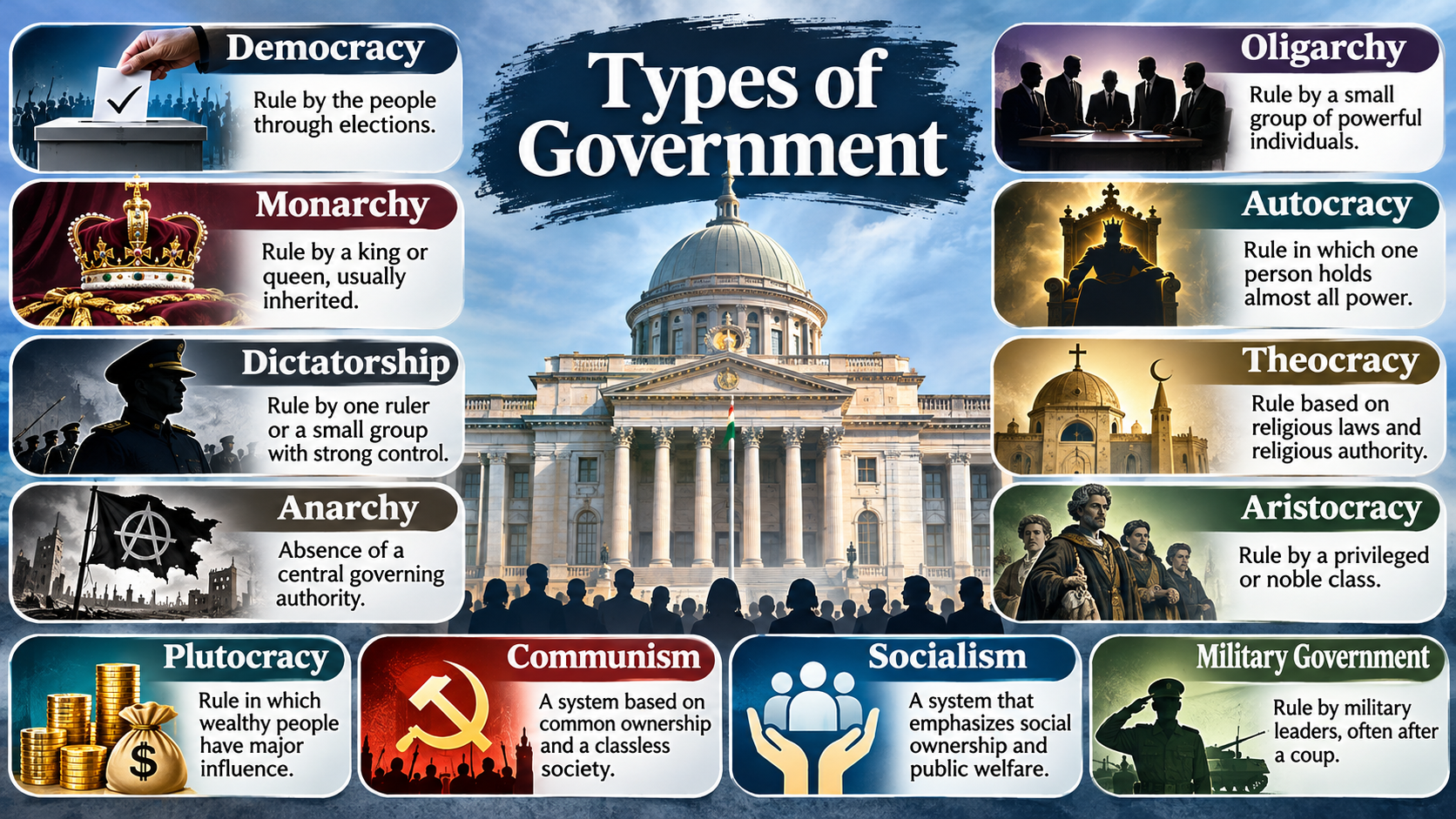
Democracy is a system of government in which people have the power to choose their leaders through elections. Citizens participate in political decisions by voting and selecting their representatives. Democracy also emphasizes fundamental rights and freedom of expression and equality and public participation. Pakistan and India and the United States are examples of countries with democratic systems.
2. Monarchy
Monarchy is a form of government in which a king or queen serves as the head of state. In most monarchies leadership is transferred through hereditary succession within a royal family. Some monarchies give the monarch extensive political powers while others limit their authority through a constitution. Saudi Arabia is an example of an absolute monarchy while the United Kingdom is a constitutional monarchy.
3. Dictatorship
Dictatorship is a political system in which one individual or a small group holds concentrated political power. In this system leaders generally exercise authority without meaningful democratic accountability. Political opposition and freedom of expression and public participation may be restricted. Nazi Germany under Adolf Hitler is a historical example of dictatorship.
4. Anarchy
Anarchy refers to the absence of a central governing authority or established state control. In an anarchic situation there is no central government responsible for making and enforcing laws throughout society. Anarchy is an important political concept although it does not necessarily mean violence or complete disorder.
5. Oligarchy
Oligarchy is a system of government in which political power is controlled by a small group of influential individuals. These individuals may gain their power through wealth or military influence or family connections or political authority. In an oligarchic system important national decisions are generally made by a limited number of powerful people rather than the general public.
6. Autocracy
Autocracy is a system of government in which almost all political authority is concentrated in the hands of one ruler. The ruler has extensive control over government decisions and does not depend on meaningful public approval. This system provides limited opportunities for citizens to influence political decisions.
7. Theocracy
Theocracy is a system of government in which religious principles and religious authorities play a central role in political administration. Laws and government policies are influenced by religious teachings and religious leaders or institutions may hold political power. Vatican City is an example of a theocratic state.
8. Aristocracy
Aristocracy is a system in which political authority belongs to a privileged or noble class of society. Historically members of wealthy and influential families controlled important government positions and political decisions. This system was particularly common in ancient and medieval societies.
9. Plutocracy
Plutocracy refers to a political system in which wealthy individuals or groups exercise dominant influence over government decisions. In this system economic wealth becomes an important source of political power. Wealthy people may influence government policies through financial resources and business connections and political influence.
10. Communism
Communism is an economic and political ideology based on the concept of common ownership of productive resources rather than private ownership of major industries and production. Its main objective is to establish a classless society in which resources and wealth are distributed according to people's needs. Historically communist states have often been governed by a single communist party. China and Cuba are examples of countries governed by communist parties.
11. Socialism
Socialism is an economic and political system that emphasizes social ownership and public welfare and reducing economic inequality. It supports the idea that important resources and industries should benefit society as a whole rather than only private individuals. Different countries apply socialist principles through public services and social welfare programs and government involvement in the economy.
12. Military Government
Military government is a system in which military leaders control the political administration of a country. It often emerges after a military coup when armed forces take control of the government. In this system military officers may exercise political authority and make national policies and control important government institutions. Pakistan has experienced military governments at different periods in its history.
Other Important Government Systems
Apart from the major types discussed above governments can also be classified according to their constitutional structure and distribution of political authority. A Republic is a system in which the head of state is not a hereditary monarch. A Federal Government divides political authority between the central government and regional governments while a Unitary Government gives primary authority to the central government. In a Parliamentary Government the Prime Minister and cabinet depend on the support of parliament. In a Presidential Government the president leads the executive branch separately from the legislature. A Constitutional Monarchy limits the powers of a king or queen through a constitution whereas an Absolute Monarchy gives the monarch extensive governing authority. A Totalitarian Government attempts to control almost every aspect of public and private life while a One-Party Government is dominated by a single political party.
Conclusion
Government systems play a fundamental role in the political and social and economic development of countries. Each system has its own characteristics and advantages and limitations and methods of distributing political authority. Some systems give citizens greater participation in decision-making while others concentrate power in the hands of one individual or a small group. Understanding different forms of government helps us examine political institutions and compare countries and understand the relationship between rulers and citizens and recognize how government decisions influence society and national development.

Comments
good job bro
Log in to comment.